Pynomina/ledger: Difference between revisions
| Line 20: | Line 20: | ||
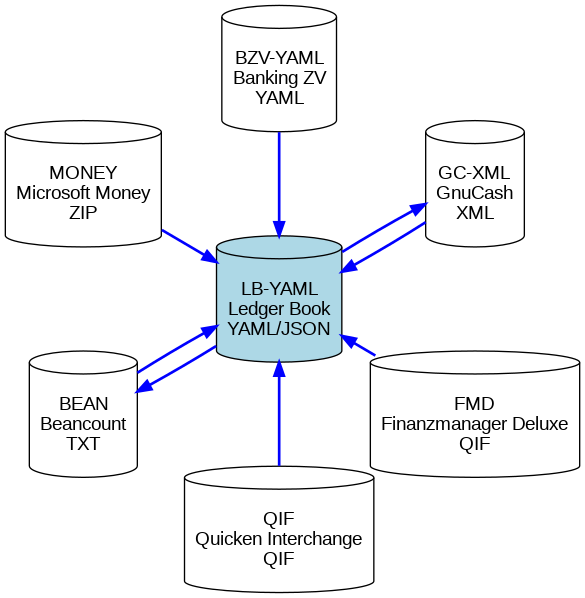
The pyNomina tool follows a '''Hub and Spoke''' model for conversion between different personal accounting file formats. The '''Ledger Book (YAML/JSON)''' format acts as the hub, with each supported format serving as a spoke. This setup simplifies conversions by allowing data to be transformed from any spoke to the hub and then to any other spoke format. | The pyNomina tool follows a '''Hub and Spoke''' model for conversion between different personal accounting file formats. The '''Ledger Book (YAML/JSON)''' format acts as the hub, with each supported format serving as a spoke. This setup simplifies conversions by allowing data to be transformed from any spoke to the hub and then to any other spoke format. | ||
https://diagrams.bitplan.com/render/png/0xa0be5aae.png | |||
=== Supported Formats === | === Supported Formats === | ||
Revision as of 03:56, 10 October 2024
see also https://github.com/WolfgangFahl/pynomina/issues/3
Motivation
In the past decades the author used different personal accounting tools:
The pain the conversion between those tools created was finally big enough to do something about it.
Goals
- use a computer and human-readable ledger format that is ready to survive decades
- convert from and to the formats of the tool of choice
- allow for simple sanity checks and reports
- allow for systematic tidy up
- allow for integration into a larger organizational knowledge graph
Hub & Spoke Conversion
The pyNomina tool follows a Hub and Spoke model for conversion between different personal accounting file formats. The Ledger Book (YAML/JSON) format acts as the hub, with each supported format serving as a spoke. This setup simplifies conversions by allowing data to be transformed from any spoke to the hub and then to any other spoke format.
https://diagrams.bitplan.com/render/png/0xa0be5aae.png
Supported Formats
| Format | Type | Description | Wikidata Entry |
|---|---|---|---|
| Ledger Book YAML/JSON | Hub | Main format of pyNomina for converting between formats. | Ledger Book |
| Beancount | Spoke | A plaintext accounting format. | Beancount |
| GnuCash XML | Spoke | An XML-based format used by GnuCash. | GnuCash |
| Microsoft Money | Spoke | Zip File exported with mny_export script using mdb-tools | Microsoft Money |
| Finanzmanager Deluxe (QIF) | Spoke | A variant of QIF used by Finanzmanager Deluxe. | Finanzmanager Deluxe |
| Quicken Interchange Format | Spoke | Quicken Interchange Format (QIF) | Quicken |
| pyNomina Banking ZV YAML | Spoke | A format for exporting banking data in YAML or JSON. | Banking ZV |
Ledger Book
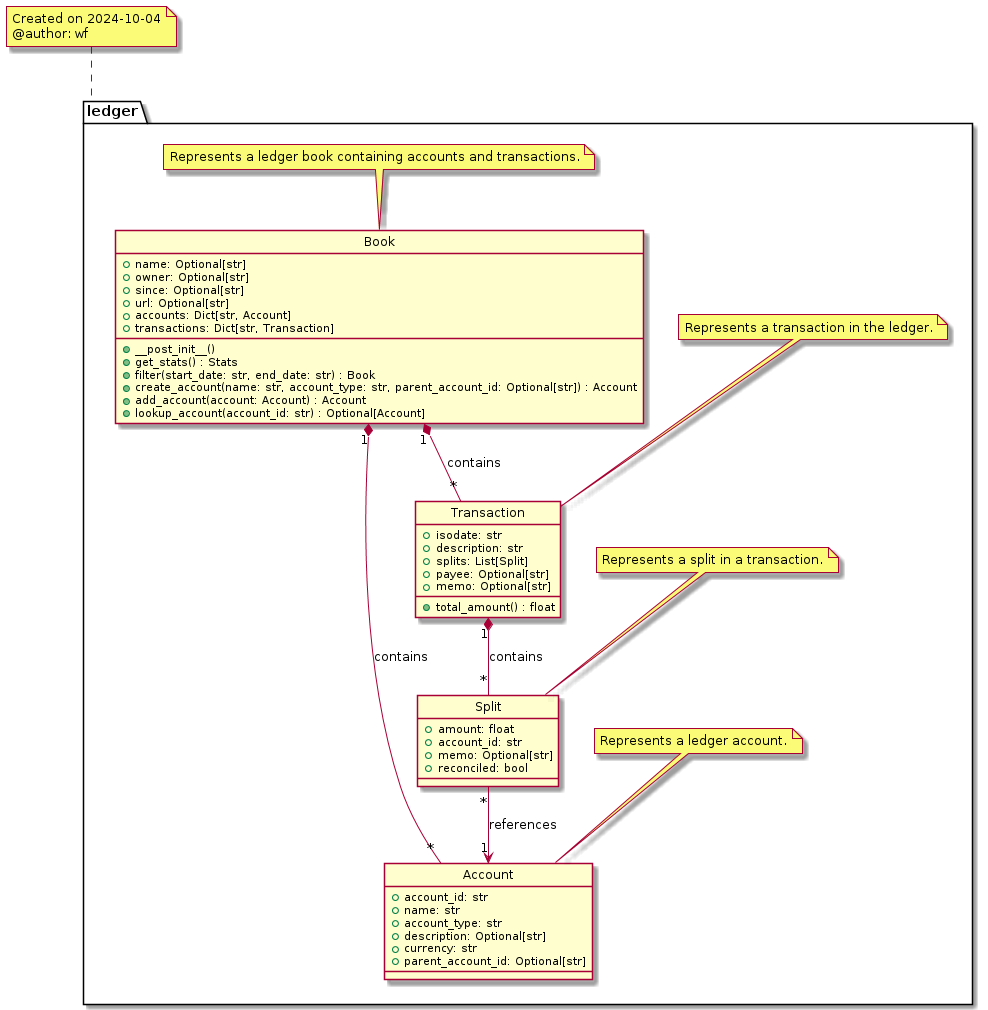
The pynomina Ledger Book model consists of four main classes:
- Book
- Account
- Transaction
- Split
These are the necessary classes which work together to represent a comprehensive financial ledger records.
Class Structure
https://diagrams.bitplan.com/render/png/0xfec2cab6.png
Book
The Book class represents the main container for all financial data. It includes:
- Basic information: name, owner, creation date, and source URL
- Collections of accounts and transactions
- Methods for managing accounts and transactions, including:
- get_stats(): Retrieves statistics about the book
- filter(): Filters transactions by date range
- create_account(): Creates a new account
- add_account(): Adds an account to the book
- lookup_account(): Finds an account by ID
Account
The Account class represents a hierarchy of individual financial accounts within the ledger. It includes:
- account_id: Unique identifier for the account
- name: Human-readable account name
- account_type: Type of account (e.g., EXPENSE, INCOME)
- description: Optional account description
- currency: Account currency (default: EUR)
- parent_account_id: Optional parent account for hierarchical structure
Transaction
The Transaction class represents individual financial transactions. It includes:
- isodate: Date of the transaction in International Standards Organization date format yyyy-mm-dd
- description: Description of the transaction
- splits: List of Split objects representing the movement of money
- payee: Optional payee information
- memo: Optional additional notes
- total_amount(): Method to calculate the total transaction amount
Split
The Split class represents the individual components of a transaction, showing how money moves between accounts. It includes:
- amount: The amount of money involved in the split
- account_id: The account associated with this part of the transaction
- memo: Optional notes for this split
- reconciled: Boolean indicating if the split has been reconciled
Example Data
Here's an example of how the ledger model is used in practice:
Yaml Format
owner: Wolfgang Fahl
url: https://github.com/WolfgangFahl/pynomina/blob/main/nomina_examples/expenses2024.yaml
since: 2024-10-06
accounts:
  Expenses:
    account_id: Expenses
    name: Expenses
    account_type: EXPENSE
    description: 'General Expenses'
    currency: EUR
  Expenses:Food:
    account_id: Expenses:Food
    name: Dining
    account_type: EXPENSE
    description: 'Expenses for Food'
    currency: EUR
    parent_account_id: Expenses
  Cash in wallet:
    account_id: Wallet
    name: Cash in Wallet
    account_type: EXPENSE
    description: ''
    currency: EUR
transactions:
  Bakery2024-10-06_0900_1:
    isodate: '2024-10-06'
    description: Bread
    splits:
      - amount: -3.50
        account_id: Cash in Wallet
      - amount: 3.50
        account_id: Expenses:Dining
        memo: Fresh sourdough bread
  Bakery2024-10-06_0900_2:
    isodate: '2024-10-06'
    description: Buns for Breakfast
    splits:
      - amount: -2.40
        account_id: Cash in Wallet
      - amount: 2.40
        account_id: Expenses:Dining
        memo: 4 whole grain buns
Implementation
The ledger model is implemented in Python, utilizing dataclasses and type hinting for clear and maintainable code. The `@lod_storable` decorator is used to enable easy serialization and deserialization of the data in YAML and/or JSON and other formats. The core idea is that the records should be readily available an tabular "list of dicts (lod)" format.